
Fast Facts
- Location: Chittorgarh, Rajasthan
- Built By: Chitrangada Mori
- Occupants: Mauryas of Chittor, Guhilas of Medapata, Sisodias of Mewar
- Area: 691.9 acres
- Current Status: The fort has been declared as UNESCO World Heritage Site
- Visiting Time: 9:45AM – 6:30PM
History of the Fort
In ancient India, the place where the fort is currently present was known as Chitrakut. Due to the ancientness of this fort, there are no clear evidences supporting the origin of the fort. There is however, a bunch of theories that are still subjected to debates. The most common theory states that Chitrangada Mori, a local Maurya ruler built the fort. A water body which was situated next to the fort is said to have been created by the legendary hero of Mahabharata, Bhima. The legend has it that Bhima once struck the ground with all his might, which gave rise to a huge reservoir. Bhimlat Kund, an artificial tank next to the fort, was where the legendary reservoir once sat, it is said.
Thanks to the fort’s majestic appearance, many rulers in the past have tried to capture it, in an attempt to make it their own. Bappa Rawal of the Guhila dynasty was one of the earliest rulers to have captured the fort successfully. It is said that the fort was captured by him around 730 AD, after defeating the Moris, to whom the fort once belonged. Another version of the story states that Bappa Rawal did not capture the fort from the Moris but from the Arabs, who had captured it from the Moris, even before the arrival of Bappa Rawal. It is said that Bappa Rawal was part of the army led by Nagabhata I of the Gurjara Pratihara dynasty. It is believed that this army was mighty enough to defeat the famous troops of Arab, who were considered imperious on a battle field back then. Another legend has it that the fort was given as part of dowry to Bappa Rawal by the Moris, when they gave the hand of one of their princesses in marriage to Bappa Rawal.
Architecture
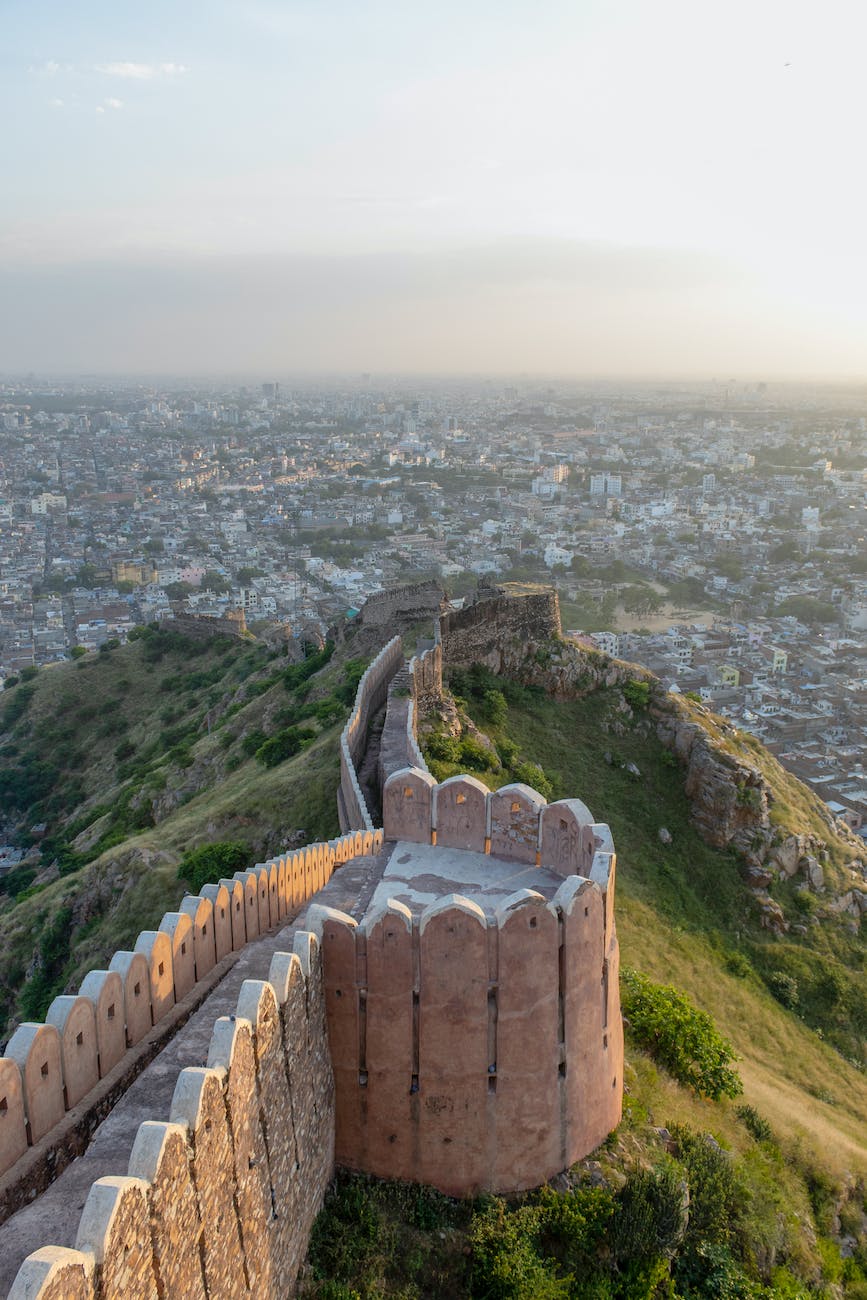
All the seven gates of the fort are nothing but massive stone structures, aimed at providing maximum security from the potential threat of enemies. The entire fort is built in such a way that it makes it almost impregnable for the enemies to enter. To ascend the fort, one has to go through a difficult path, which itself proves that the architectural design of the fort was aimed at keeping the enemies at bay. This is one of the main reasons why the fort was sieged by various kings at regular intervals. In between the second and the third gate there are two Chhatris or cenotaphs, built in honor of Jaimull and Patta, the heroes of 1568 AD when the fort was sieged by Emperor Akbar. These cenotaphs are considered as architectural marvels. The tower of the fort is nine storeyed and is adorned with sculptures of Hindu deities and stories from the Ramayana and the Mahabharata. The tower provides a breathtaking view of the city.
Layout of the Fort
The fort, when viewed from above, looks roughly like a fish. Spread across an area of 700 acres, the circumference of the fort alone covers an area of 13 kilometers. There are seven massive gates, safeguarding all the entrances. The main gate is called as Ram Gate. The fort has 65 structures including temples, palaces, memorials and water bodies. There are two prominent towers within the premises of the fort namely Vijay Stambha (Tower of Victory) and Kirti Stambha (Tower of Fame).
 indiannature.travel.blog