
Fast Fact
- Location: Agra, Uttar Pradesh
- Built By: Akbar
- Built in the Year: 1573
- Purpose: Main residence of the Mughals
- Area: 380,000 square meter
- Current Status: The fort is a UNESCO World Heritage site
- Visit Timing: Sunrise to sunset
- Entry: Entry to Agra Fort is allowed through the Amar Singh Gate only
History of the Fort
Agra Fort is known for its rich history. The fort has been owned by many emperors and rulers in the past, undergoing many changes in its appearance. It all began in the year 1526 when the first battle of Panipat was fought between Babur and Ibrahim Lodi of the Lodi dynasty. When Babur defeated Ibrahim Lodi, he made the fort and the palace of Ibrahim Lodi as his home. He then modified the fort by building a huge step well (baoli) inside. The fort soon became an important monument to the Mughals. In fact, Babur’s successor, Humayun’s coronation took place at the fort in the year 1530.
Soon emperors from other dynasties started eyeing the fort and efforts to win over the same began. In 1540, Sher Shah Suri of the Sur Empire waged a war against Humayun and defeated him at Bilgram. Sher Shah Suri took over the ownership of the fort from Humayun and made minor changes to it, so as to suit his own architectural taste. The fort stayed with the emperors of the Sur dynasty for the next 15 years. In 1555, Humayun managed to recapture Agra and with it the fort as well. But a year later, Hemu Vikramaditya, the general and military commander of Adil Shah Suri (final emperor of the Sur dynasty) captured Agra. He pursued the fleeing army to Delhi and the Battle of Tughlaqabad ensued between him and Tardi Beg Khan, the military commander of the Mughals.Tardi Beg Khan lost the battle convincingly and Hemu Vikramaditya crowned himself the king. However, on November 5 1556 and barely a month into the kingship of Hemu, Akbar, along with his army, marched into Delhi and defeated the forces of Hemu. The fort once again belonged to the Mughals, but was fast disintegrating. Back then, it was known as Badalgarh and was built with bricks alone. Realizing its historical and situational significance, Akbar decided to rebuild it with red sandstone.
Architecture
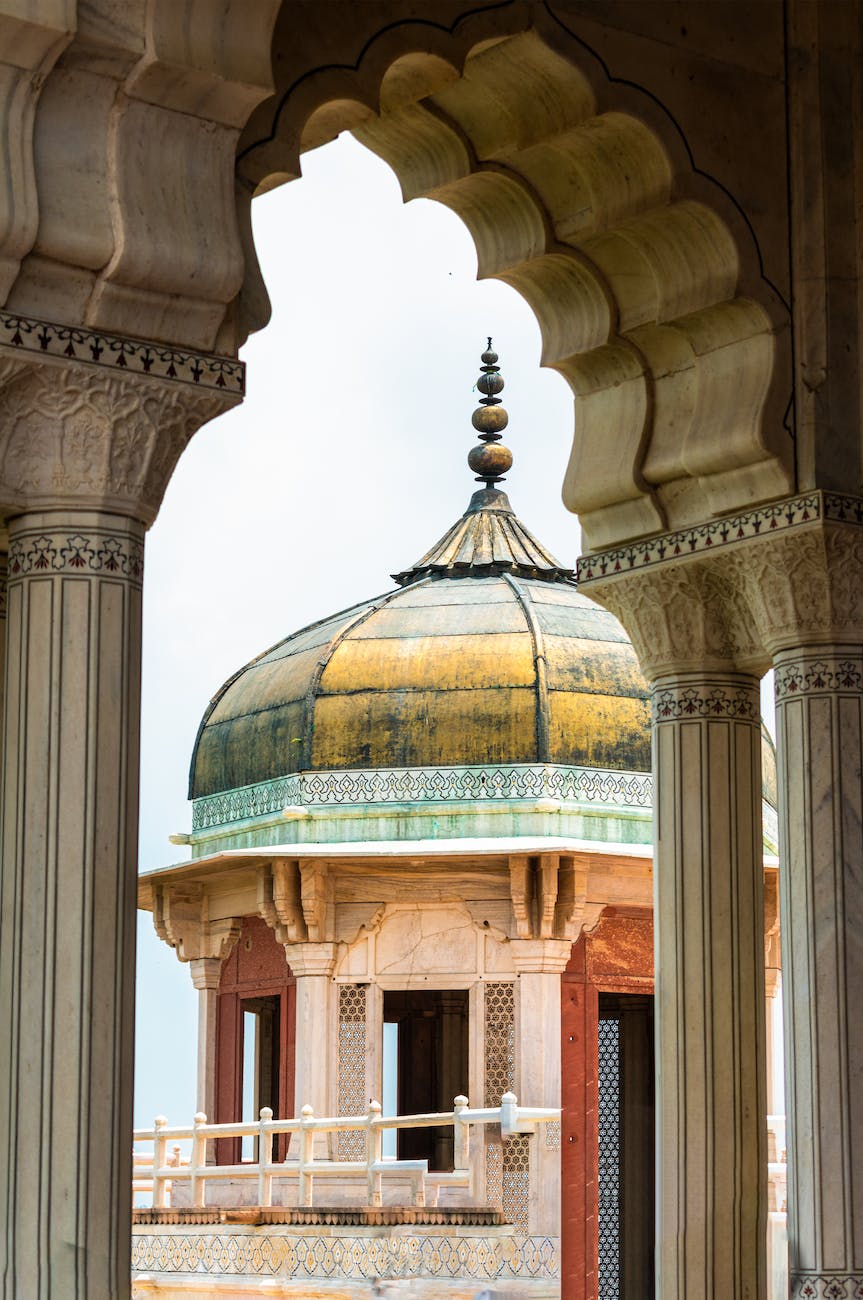
Bricks formed the base of Agra Fort’s structure. Red sandstone was brought all the way from Rajasthan and that was laid on the external surfaces. Back then, the entire fort was built using the red sandstone. This appearance of the fort underwent a major change during the reign of Shah Jahan. Unlike his grandfather, Shah Jahan was smitten by the beauty of white marble. Hence, he destroyed many structures within the fort, only to rebuild them using white marble. Shah Jahan was made to spend his final days in the Musamman Burj of the Agra fort, which was built by him.The Musamman Burj is located on the left of the Khaas Mahal. It is a beautiful octagonal tower with an open pavilion. It is said that Shah Jahan used to view the Taj Mahal from this very place.When the British took over the ownership of Agra Fort, much more changes were made to the fort. They destroyed many structures and edifices with historical significances, citing political reasons and for raising barracks. The structures that managed to survive showcase the real complexity and workmanship of Mughal architecture. Fine examples of the Mughal architecture within the fort are the Delhi Gate, Amar Singh Gate and the Bengali Mahal. These structures not only represent Mughal architecture, but are also fine examples of Akbari architecture which is also known as Indo-Islamic architecture. Among these structures the Delhi Gate is considered as the most prominent for its workmanship and architectural design. Even today, it is regarded as one of Akbar’s masterpiece. Speaking about masterpiece, there is an interesting legend associated with the architecture of the Agra Fort. It is said that the royal rooms of the fort were built in such a way that they would remain cool even during the summer. The legend has it that the walls were made hollow and then filled with water from the river, so that they would remain cool.
 indiannature.travel.blog